Do you want to automatically know when I post something new? Very easy! You can subscribe to:
my RSS feed: Copy this link “https://www.theotherjulia.com/feed” and paste it here into the box “Feed URL” alongside your email address. You will receive an email (and nothing else!) when I’ve posted something new.
I get asked about breathing quite a lot when I give my training courses and especially when we get to the topic of animating life when the character does nothing at all, doesn’t move (what I’ve been calling animating “nothingness”, which is important to keep as exactly that: nothing – no movement, but still some life). It’s extremely difficult. But making the character breathe just because they’re not moving is not the answer. Partly because we don’t see people breathe in normal life and partly because well… you haven’t made your character breathe before that point, did you?
However, of course we animate the character breathe in very particular circonstances. Like, obviously, if we hear in the sound their heavier-than-normal breathing. Or when it goes along a physical effort (even if you don’t hear it in the sound). Also when the character sleeps because it’s absolutely expected by the viewer in this total stillness (the viewer will feel like suffocating if you don’t make your character breathe on screen while sleeping – empathy is a magical thing!). Not forgetting too: when the character sings. Don’t forget to place some breathing intakes, even though music will drown that type of sound and you will therefore not have any clues when to place those! You will have to figure out when and animate them.
So, this is all well and good, but how to animate a stop-motion character breathe? It can be extremely tricky. First, let’s talk about body parts going where and how: with the lungs filling up with air, the chest puffs out and with the exhale of air, the chest empties out, meaning it goes inwards. Which is not something we can easily do, unless we have a rockstar puppet from the model-making department (basically most of us will not encounter a puppet like this, ever – I only did on the short film “Un Coeur d’Or” by Simon Filliot). So we have to cheat to give the impression. With the chest filling in with air, we can raise the shoulders a teeny bit and lower the chin a teeny bit, to give the illusion. And the reverse motions of shoulders and chin for the chest emptying/exhaling. This is one cheat. Sometimes I don’t have great access to shoulders, but I do have separate clothes. In this case, I can act on these, pulling on the clothes outwards and raising the chin for the chest filling in and pushing the clothes and the chin in a bit for the chest exhaling. The manipulation can be a bit tricky in order to get under the top that the puppet is wearing and it might require to make yourself a custom tool.
Case in point, these last months, I’ve been animating on “Včasih sem Papirnati Zmaj”) (Sometimes I am a kite), a short film by director-animator Leon Vidmar. I’ve had you guys in mind that whole time and I made photos and videos to share with you. For example, I made a video of the breathing I did, with what tool, what increments and for what results. Here’s the tool. Nothing flashy as you can see, just a twisted and shaped bit of aluminium wire:
And now, here is the resulting breathing motion, first the movement frame-by-frame, then full-speed:
If your stop-motion puppet doesn’t have clothes and you want to act on more things than just chin and shoulders, you can act on the texture (plasticine, silicone, resin, paper, wool, you name it…) by brushing the surface always one way; then always the other way (albeit minimally!) to affect the texture itself or the way the light reflects on it and therefore mimick an exhale and an inhale.
You might have noticed in the examples I gave earlier that, in one example, I animate the chin in the direction of the chest filling up, and in the other example, I animate the chin in the counter-balancing direction to the chest filling up. It doesn’t depend on what other elements you animate with it, it depends on how strongly you consider your character is breathing in and out and/or on how mobile and independent the neck is for your character in the context of the scene. As most often is the case with animation, try out both options on your own body or on a colleague’s and what you should do between these 2 options will become apparent.
I hope it helps you guys negotiate the rather rare times we have to animate breathing.
As always, if you find this advice useful, don’t hesitate to tell your animation friends about this blog. I will write up and upload more tips from that Leon Vidmar’s short film very soon!
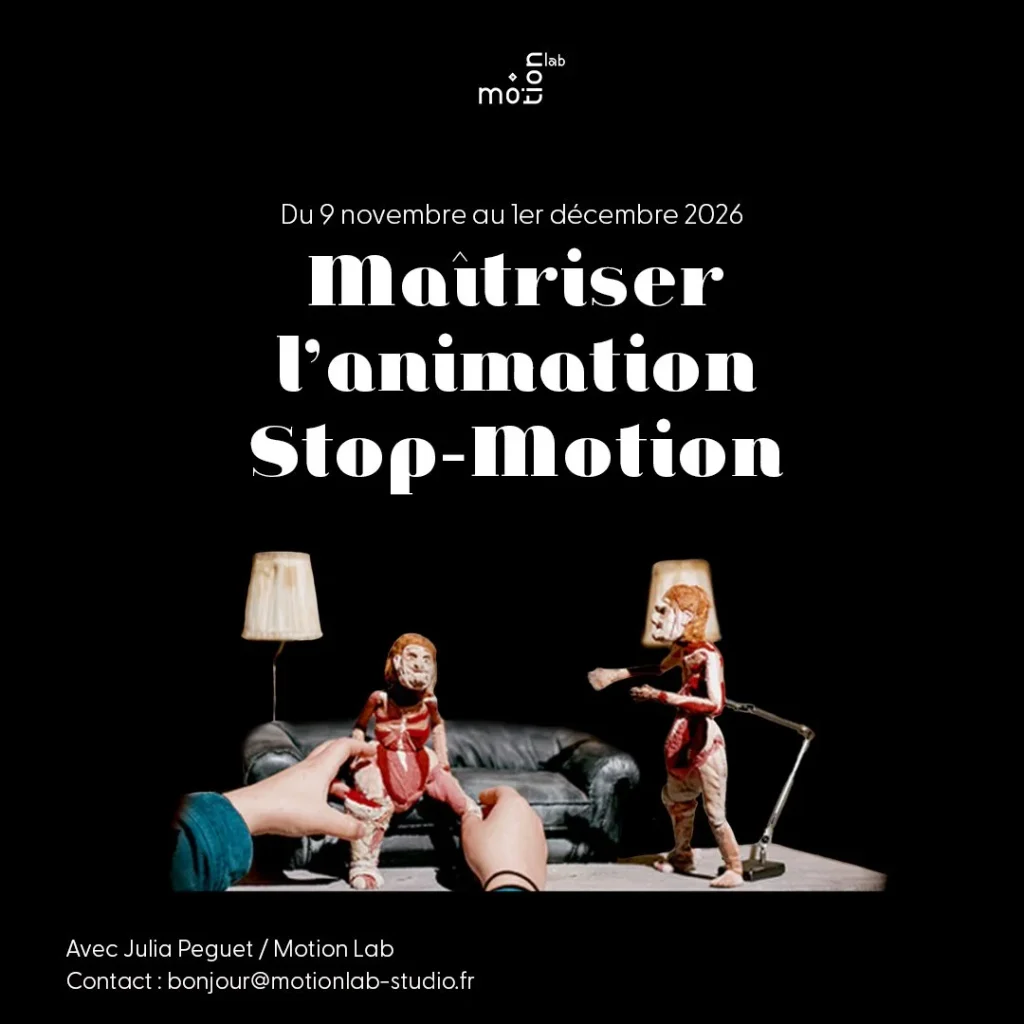
After the awesome Level-2 training course coming this spring, here’s an opportunity for a level-1 course in the beautiful city of Nantes, France, this November!
Participants (you!) are expected to have some basic understanding of what animation is and you might have tried for yourself, but you feel you need guidance to take all the right habits and continue your junior journey with a ton of tips and tricks of the trade! The past editions of this training course with MotionLab have been a ton of fun in a very supportive and professional environment. It’s also open to international participants! The cost for whoever doesn’t have rights with AFDAS is 3500€ (for those who do, it’ll be more expensive but fully covered).
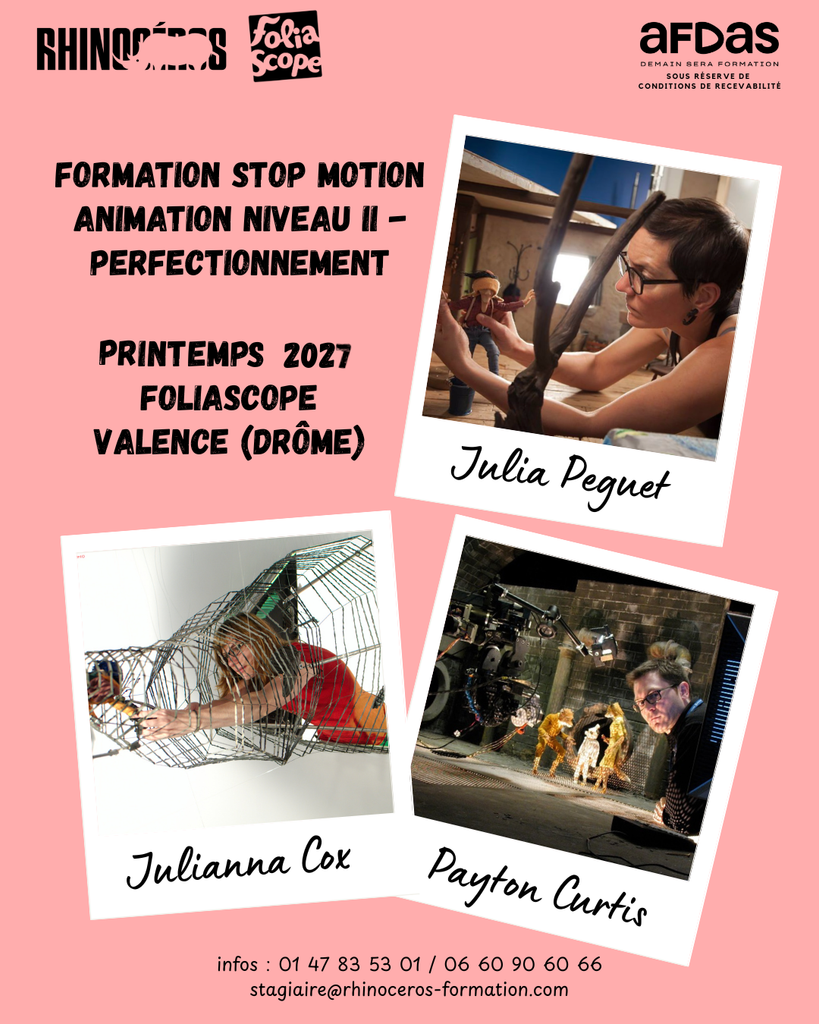
Hi all! I have extremely exciting news about an upcoming training course! I have teamed up with 2 of the best animators (with Laika and Aardman credentials) to offer a Level-2 animation training course with our good friends from Rhinoceros Formations.
The amazing thing is that it is open internationally! Meaning anyone can apply, it will be held in the Foliascope Studio in France and it will be held in ENGLISH!
For French participants who have rights within the AFDAS system, the course is fully funded. For international participants, the course will cost 5600€ before tax or 6720€ tax incl. (maybe some of you can find an agreement with a studio you work with or can ask for fundings or aids in your own country)
The course is Level-2 Animation meaning it’s of course more advanced than the courses I usually offer. This is a FIRST and it’s very exciting indeed!
Yes, there will be a selection so that we are sure to give appropriate training to people who are ready to receive this training, but (and I cannot emphasise this enough) you may not be the best person to judge yourself – precisely because you are not a very experienced animator, you might actually be missing (as of yet) the skills to notice the good stuff, the promising parts, the bits with potential. I’ll tell you a story (which some of you know) to illustrate my point: In 2003, I had animated a handful of seconds in stop-motion animation, with broken puppets, on a table in my flat. I was sending this very meagre demoreel around and was being rejected. Until someone told me Aardman was looking for animators. Not knowing if I should laugh or cry, convinced that I had no chance, but knowing that hell! I had nothing to lose anyway, I sent it and promptly forgot about it. Would you know, I got called in for a test and off of that test, they offered me a spot as an animator! And I worked there back-to-back for almost 10 years! Julianna and Payton both absolutely have similar stories. Both their animation careers started off just as humbly and they both became Laika animators!
Lately, I’ve been enjoying a period of well-deserved leisure after a long succession of many jobs. But of course, because this is me we’re talking about, I also glanced at my “not-urgent to-do list”.
Almost a year ago now, before I went to work on Out of Words at Wiredfly, a friend who is debuting as a director, Sašo Dudić, asked me to animate his production-company logo to put in front of his short films. The idea was extremely appealing and the timing was initially good in my head: I could animate a quick little thing on one of the units at Wiredfly on a weekend or at the end of a working day. Ha ha ha! How delusional of me! Of course, I had no time at all either side of a working day at Wiredfly, what with having a dog who also requires 2-hour walks every day and weekends were not any better, having far less overall “work” capacity after 25 years in the industry.
So here we are, a year later, fully rested and enjoying a leisurely period, and deciding almost on a whim to switch the lights on and sculpt my way through the animation of Broken Arm.
I walked into the downshooter unit of the very kind-hearted association/production company Dagiba, in Ljubljana (fronted by the extremely talented animator-director Timon Leder who let me shoot for free), with only a bit of plasticine, 2 bones that I salvaged out of a Halloween toy (good timing!) and pretty much no idea what I was actually going to do with this Broken Arm concept.
The participants of my animation training course have heard me hammer time and again how important it is to prepare one’s shot. Well, I did exactly …the opposite. I had a very faint idea of what I’d like (the dynamic tearing of the skin leaving two bits of bones exposed and falling like broken clock hands at the very end, but no idea how to do the tearing, what the timing should be, or the actual squash & stretch motion, not even whether I’d have shirt sleeves or not. I improvised each frame all the way until about mid-shot where I had a clearer vision til the end. Sometimes you just gotta have fun
And I hadn’t even told Sašo that I was shooting his logo that day, because I wanted no pressure at all to even complete it there and then. I wanted just fun!
Well, this little productive tantrum for sure made someone happy. Some-2 actually, because I had had an absolute blast sculpting through that plasticine animation all day, of course! But he also was over the moon, extremely touched that I did it at all and he loved it! I hope you do too.
There’s nothing like the pure joy of animation when you don’t have deadlines or even a brief 😅🤣
Hi everyone! Today, I want to talk about dynamic movements, using 2 examples that I animated. The first one from “The Pirates! In an Adventure with Scientists“, shot at the studios Aardman Animations. This scene comes right after the previous clip on this blog thread. Pirate Captain is struggling for a beat to get the sword to cut the sausages then it comes through at once.
When you’re a junior animator, it can be very daunting to create increments between the images that are extremely far apart in space. We’re so used to having frames that look almost identical to the previous one that it becomes a bit of a mechanical habit in our animations. Dynamic movements demand that you go bold and that increments, at the heart of the action, are very different – that the movement has progressed almost entirely from one frame to the next. You rarely, if ever, need to show the middle poses. It would kill your effect, which is to go big and go fast. Here’s the clip:
The secret of dynamic movements is what I call “pre-analysis” and “post-analysis” for the brain. It’s there to give your brain information before and after the move. We’ll see about after the move further below, but for now, the pre-analysis before the move will allow the brain to anticipate (yes, it’s often the anticipation that you’ve learnt about in animation class) an action that your brain will not have time to actually see, because it will be too fast. So here, the struggle is maintained in time to create pre-analysis – the brain is already now understanding what’s coming. Then when the brain doesn’t see the action so clearly, it actually sort of has, because it “saw” it before it even happened.
Here it is frame by frame:
You can see that the increments at the heart of the action have gone real far very suddenly. You can have a sense of when I go into 1’s (this means shooting every single one of the poses in my 24 fr/sec rate), because “far-away increments” means that they’re hard to connect together for our visual system, so you need to show a differentiated, second pose while keeping the overall timing. And you can see when I go back to shooting in 2’s (that’s when I take 2 identical frames for one pose, in my 24 fr/sec rate) because there’s a sausage that cheekily moves a bit 😁
Now, in the same line of thoughts, here’s a clip from “Ecorchée“, a fantastic short film by Joachim Hérissé, that I animated on:
Same theory here, but I want to talk about what’s happening on the other side of the heart of the action: the “post-analysis” that I mentioned. This one gives a chance for our brain to reconstruct what it barely saw. In this case, it’s the rebound of the body of Ecorchée and it’s the swaying of the bunny corpse that will piece things together and confirm what happened.
Of course, in a lot of animations, whether it is the pre-analysis or post-analysis, these two moments often correspond to the anticipation and the rebound (or cushioning, or ease-in and -out, however you’re used to call them). But these are mechanical laws of movements. Whereas here, I’m talking about perception, because it is these perception laws of pre- and post-analysis (as I call them) that are key to your dynamic animations.
Here it is frame by frame. Interestingly you will see that I do have a mid-course frame of the skinning itself. I tried without but it didn’t work, so I did that mid-skinning pose. I’m mentioning it because it should always be your bias to try to make it work without those heart-of-the-action poses, as I mentioned earlier. If you will skew in one direction, favour the good ol’ saying “less is more”. But for this one shot, it needed it. Let’s see:
So when you’re doing a very fast action, you don’t actually save that much in number of frames overall, because you need to create more frames, more focus, more time before the move and after the move (pre-analysis and post-analysis – or anticipation and rebound if it also translates mechanically on the elements) than your regular, normal-speed, bumbling-about animation move.
I hope this helps! Practise and test the speed, increments and perception for yourselves!
Today I’d love to share this full plasticine character that I animated for Out of Words, directed by Johan Oettinger. I had a blast the entire time! Stop-motion animation (let alone video games!) is not using plasticine (clay, in American English) all that often and those who know me are well aware that I swear by it!
This shot is featuring one of the recurrent characters of the game who finds themselves in quite the pickle initially. There is a relatively simple armature in the character’s chest and arms (made by Wiredfly’s model-making department) because the size is really quite big to fit the size of the giant hand that was made beforehand. Of course, a bigger size means more weight – plasticine can get heavy quite fast – so in order to sustain that weight in the long and relatively thin arms, it is advised to have an armature. But other than the arm+chest armature, the character is fully plasticine. What a joy for me!
Plasticine is the only material that effortlessly puts me in the zone and nothing is a struggle, even when on the face of it, everything should be a struggle: here, the sheer size of the character, the amount of plasticine to push and pull around to model each pose, plus sculpt-through lip-sync with teeth to take out and put back in all the time, all of this with a tight deadline, I felt stressed initially but very quickly the elation and flow of modelling plasticine throughout the entire 10-second shot totally overrode everything and reminded me why I fell in love with this art and why I wanted to make it my job.
I was so privileged also to work with the Wiredfly team, because Johan, the director and Mikkel Maltesen, the Art Director, gave me free rein in the transformations of the facial elements. I had very little time but I certainly had a ton of fun!
This is a shot I animated for The Pirates! In an Adventure with Scientists, directed by Peter Lord and Jeff Newitt. Be careful, it’s a shot from the climax sequence, so it’s very short! Action, action!
I want to show it to talk about rigging. Disclaimer: I don’t have access to the raw footage, so I will not be able to show you the rigging before the shot was cleaned up, but hopefully I can describe things well enough. The character was rigged in the conventional way, with a ball-and-socket fly rig. The strings of sausages that were flying alongside the character were a little bit of a puzzle though. How to keep them up in the air and also allow for the animation of their individual flying movements? The props department built in some aluminium wire along the string of sausages but it proves insufficient to sustain the weight, what with the maximum size aluminium wire that would be acceptable for these items and the leverage weight of the length of sausages. I asked the rigging department to provide me with a metallic plate, that could be placed above the entire course, like a ceiling because it was not disrupting the lighting of the scene, and to provide me with magnets. I then tied a few fishing wire lengths to the strings of sausages. The fishing wire connected the sausages to the ceiling-metal plate and the magnets were catching that fishing wire and kept it in place on the plate. Ta-dah! Rigging was done! All that was left for me to do was to adjust the length of the fishing wire while advancing the magnets along the plate for each frame.
Here is the flying part of the shot, frame-by-frame:
Today, I want to show 2 shots from Out of Words, following each other, then the timelapse of one. They’re featuring the 2 main characters of the game who have really interesting layers in their personalities and in their feelings, just like the rest of us, they’re so relatable!
I love animating changes or a conflict of emotions, being torn between our loyalty towards different people or situations, playfulness, gentle teasing… all of these animations are oh-so delicious to work on!
The following video is a timelapse of the previous shot:
To kick things off with this blog, I’d like to share the animation that I have been working on lately. It’s an unlikely and awesome animation production: a stop-motion game, of all things, called Out of Words, by the studio Wiredfly and Kong Orange, based in Denmark. Have a look, it’s so beautiful!
These two shots from @outofwordsgame go together and were not initially planned like this. Only the second one was planned (this one below) but when I finished animating it, we asked for feedback from the team. It came out that it was a bit hard to understand what’s going on at this speed and with this tight framing, so Johan Oettinger, the director, decided that I animate a wider, slower shot (the one above) to edit them together into one smooth sequence. You’ll see them edited together when you play the game!